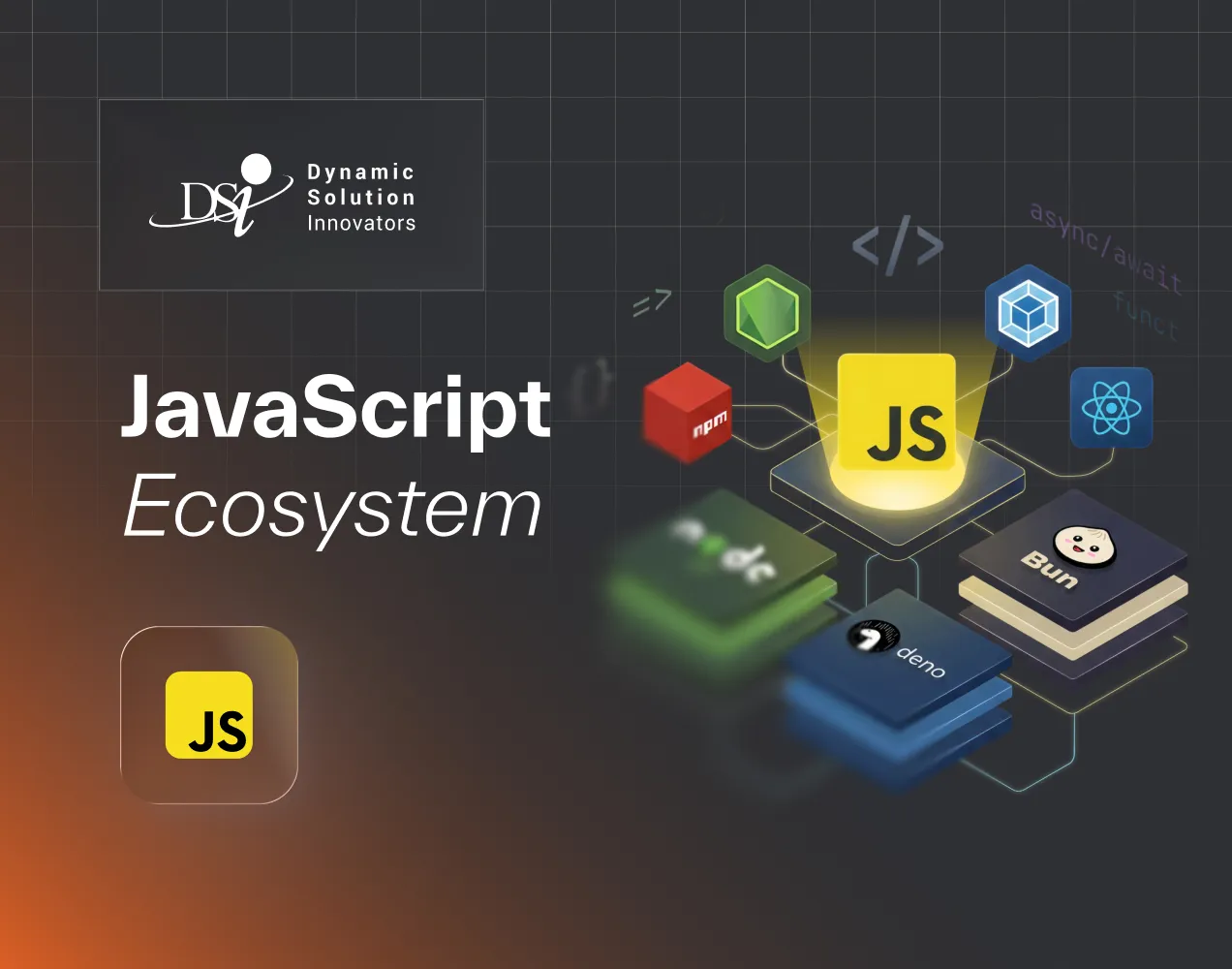
The JavaScript ecosystem has never moved slowly, but 2025 feels different. After years of churn — new frameworks every quarter, build tools that went from essential to obsolete in eighteen months, and an endless debate about whether TypeScript should be the default — the landscape is finally settling into something that resembles maturity. React 19 landed in December 2024 with Next.js 15. Deno 2.0 shipped in October 2024 with proper npm compatibility. Bun 1.x has proven itself in production. Not everything is stable, and not everything should be. But for the first time in a long time, engineering teams can make tooling decisions with reasonable confidence that those decisions will hold for more than a year.
This guide covers the tools, runtimes, and patterns that matter for production JavaScript right now. We are not ranking frameworks or declaring winners. We are mapping the ecosystem as it actually exists for teams that ship software — the choices that are stabilizing, the areas still in flux, and the practical trade-offs that should drive your decisions.
If your team is building or maintaining JavaScript applications at scale, this is the landscape you are operating in.
The Runtime Wars: Node.js vs. Bun vs. Deno
For over a decade, Node.js was the only serious server-side JavaScript runtime. That is no longer the case. Bun and Deno have matured from experimental projects into production-viable alternatives, each with a distinct philosophy and set of trade-offs.
Node.js: the incumbent that keeps shipping
Node.js is not standing still. The v22 LTS release brought experimental TypeScript stripping via the --experimental-strip-types flag, a maturing permission model, and continued improvements to the built-in test runner. The ecosystem compatibility is unmatched — virtually every npm package works, and the operational knowledge your team has built over years still applies.
Where Node.js shows its age is startup time, cold-start performance in serverless environments, and the fact that its tooling story still requires assembling multiple pieces. You need a separate bundler, a separate test runner (unless you use the built-in one, which is still catching up), and a separate TypeScript compiler or loader. Node.js works. It just requires more configuration to get a modern developer experience.
Bun: speed as a feature
Bun's pitch has always been speed, and it delivers. Built on JavaScriptCore instead of V8, Bun consistently benchmarks faster for startup time, package installation, and test execution. But the real story is that Bun has moved beyond benchmarks into genuine production readiness. The npm compatibility layer handles the vast majority of packages, the built-in bundler is stable, and the native test runner is fast enough to change how teams think about test execution time.
Bun's all-in-one approach — runtime, bundler, test runner, and package manager in a single binary — eliminates an entire class of configuration and compatibility problems. For new projects, this simplicity is a real advantage. The trade-off is that when something breaks in Bun's integrated toolchain, you are debugging a single opaque system instead of swapping out a modular component.
Deno: security and standards
Deno took a different path. Its focus on web-standard APIs, secure-by-default permissions, and first-class TypeScript support appeals to teams that prioritize security and correctness. Deno 2 improved Node.js compatibility significantly — you can now use most npm packages through the npm: specifier — which removed the biggest adoption blocker.
Deno's strength is in environments where security boundaries matter: edge functions, serverless workers, and multi-tenant platforms where you want fine-grained control over what code can access the file system, network, or environment variables. Its built-in tooling (formatter, linter, test runner, benchmarker) is polished and cohesive.
Choosing a runtime
| Factor | Node.js | Bun | Deno |
|---|---|---|---|
| Ecosystem compatibility | Best — near-universal npm support | Very good — most npm packages work | Good — npm: specifier covers most cases |
| Startup performance | Moderate | Fastest | Fast |
| TypeScript support | Native stripping (v22+) | Native, first-class | Native, first-class |
| Built-in tooling | Test runner, basic | Bundler, test runner, package manager | Formatter, linter, test runner, benchmarker |
| Security model | Permission model (opt-in) | Standard (no sandboxing) | Secure by default (opt-in permissions) |
| Production track record | 15+ years, battle-tested | Growing, 2+ years production use | Established, strong in edge/serverless |
| Best for | Existing apps, maximum compatibility | New projects, performance-sensitive | Security-critical, edge deployments |
The practical reality is that most teams are still running Node.js in production — and that is a perfectly reasonable choice. The question is not whether to abandon Node.js but whether your next project would benefit from the specific advantages Bun or Deno offer. If you are starting fresh and your dependencies are compatible, Bun's integrated toolchain and raw speed make it worth serious evaluation.
Build Tools: The Post-Webpack Era
Webpack defined JavaScript bundling for nearly a decade. Today, the ecosystem has largely moved on — not because webpack stopped working, but because a new generation of tools delivers dramatically better performance with less configuration. The three tools that matter are Vite, Rspack, and Turbopack.
Vite: the new default
Vite has become the default build tool for most new JavaScript projects. Its dev server uses native ES modules for near-instant startup regardless of application size, and its production builds use Rollup for efficient, tree-shaken output. The Vite team is working on Rolldown, a Rust-based Rollup replacement, which promises even faster production builds when it ships. Every major framework — React, Vue, Svelte, Solid — has first-class Vite support.
What makes Vite the default is not just speed but developer experience. The configuration is minimal, the plugin ecosystem is mature, and hot module replacement works reliably across frameworks. For teams that want to stop thinking about their build tool and start thinking about their product, Vite is the answer. If your organization is still on webpack and wondering where to invest engineering effort, migrating to Vite is one of the highest-return technical debt reduction efforts you can undertake.
Rspack: webpack-compatible, Rust-powered
Rspack takes a different approach: full webpack API compatibility, rewritten in Rust for dramatically better performance. If your codebase relies heavily on webpack loaders and plugins, Rspack lets you get 5x to 10x faster builds without rewriting your build configuration. This is not a theoretical improvement — large applications that took 60 seconds to build with webpack can build in 6 to 10 seconds with Rspack.
Rspack is the pragmatic choice for teams with large existing webpack codebases that cannot justify a full migration to Vite. The webpack plugin compatibility is not perfect — some edge cases in complex custom plugins still require adjustments — but for the vast majority of configurations, it is a drop-in replacement.
Turbopack: the Next.js path
Turbopack is Vercel's Rust-based bundler, designed primarily for Next.js. If your team uses Next.js, Turbopack is increasingly the default build tool — it is integrated into the framework and optimized for its specific patterns (server components, app router, streaming). Outside the Next.js ecosystem, Turbopack has limited adoption and is not designed as a general-purpose bundler.
The pattern here is clear: general-purpose projects use Vite, webpack-heavy legacy projects migrate to Rspack, and Next.js projects use Turbopack. The build tool fragmentation that defined 2020 to 2023 is resolving into a manageable set of choices.
Package Management: pnpm and Bun Lead
The npm client is no longer the default package manager for serious JavaScript projects. In 2025, the two package managers gaining the most ground are pnpm and Bun's built-in package manager.
pnpm's content-addressable store and strict dependency isolation solve real problems that npm and Yarn never fully addressed: phantom dependencies, disk space waste, and inconsistent hoisting behavior. For monorepos especially, pnpm's workspace support and strict isolation prevent the category of bugs where packages accidentally depend on hoisted dependencies they did not declare.
Bun's package manager is simply fast. Install times that took 30 seconds with npm take 2 to 3 seconds with Bun. For teams already using Bun as their runtime, the integrated package manager is the obvious choice. For teams on Node.js, pnpm is the standard.
Yarn continues to exist and Yarn Berry (v4) introduced interesting concepts like Plug'n'Play, but adoption has declined as pnpm addressed the same problems with a more conventional approach. Unless your team is already deeply invested in Yarn Berry's specific features, there is little reason to choose it for new projects.
Testing: Vitest and Playwright Own the Stack
Testing in JavaScript has consolidated more than almost any other category. The debate is effectively over for most teams.
Vitest for unit and integration tests
Vitest is rapidly replacing Jest as the default testing framework for new projects. Built on Vite, it shares your application's configuration, supports native ESM without workarounds, and runs tests significantly faster — especially on large test suites. The API is Jest-compatible, so migration is largely mechanical: change the imports and the test runner configuration.
The performance difference is not marginal. Test suites that take 45 seconds with Jest commonly run in 10 to 15 seconds with Vitest. In CI pipelines where you are running tests on every pull request, this adds up to meaningful time and cost savings. For teams maintaining hundreds of full-cycle development projects, fast test feedback loops are a direct contributor to shipping velocity.
Playwright for end-to-end tests
Playwright has won the end-to-end testing category. Multi-browser support (Chromium, Firefox, WebKit), auto-waiting that eliminates flaky selectors, trace viewer for debugging failures, and a test generator that produces maintainable test code. Cypress is still in use across many codebases, but new projects overwhelmingly choose Playwright.
The combination of Vitest for fast unit tests and Playwright for reliable end-to-end tests gives JavaScript teams a complete testing stack with minimal configuration overlap. If you are still running Jest with a custom babel transform and a separate Cypress installation, consolidating to Vitest plus Playwright will simplify your toolchain and speed up your pipeline.
Monorepo Tooling: Turborepo and Nx
Monorepos have become the default architecture for teams managing multiple JavaScript packages, applications, or services. The tooling question is Turborepo or Nx.
Turborepo: simple and fast
Turborepo focuses on one thing: making builds and tasks in monorepos fast through intelligent caching and parallel execution. Its configuration is minimal — define your task dependencies in a single JSON file, and Turborepo handles the rest. Remote caching through Vercel (or self-hosted) means CI pipelines skip work that has already been done, often cutting build times by 50 percent or more.
Turborepo is the right choice for teams that want monorepo benefits without monorepo complexity. If your primary need is "run builds and tests faster across multiple packages," Turborepo does that with minimal learning curve.
Nx: full-featured and opinionated
Nx goes further. Beyond task orchestration and caching, Nx provides code generation, dependency graph visualization, affected-command analysis (only run tests for packages affected by a change), and plugins for specific frameworks. For large teams working on complex dependency graphs with dozens of packages, Nx's additional features justify its additional complexity.
The trade-off is real: Nx requires more configuration, more team training, and a deeper commitment to its patterns. For teams that are scaling their development team, the structure Nx imposes can actually be an advantage — it enforces consistency across packages and gives new team members a clear mental model of the codebase.
Edge Computing and JavaScript
Edge computing has moved from marketing buzzword to practical reality for JavaScript teams. Cloudflare Workers, Vercel Edge Functions, Deno Deploy, and AWS Lambda@Edge all run JavaScript at the network edge — closer to users, with lower latency, and with a fundamentally different execution model than traditional server deployments.
The key constraint is the runtime environment. Edge functions run in stripped-down JavaScript runtimes with limited APIs, short execution time limits, and no persistent file system. Code that works perfectly on a Node.js server may fail at the edge because it depends on Node-specific APIs, expects long-running processes, or uses packages that assume a full operating system underneath.
Today, the practical use cases for edge JavaScript have settled into clear categories:
- Request routing and middleware: Authentication checks, A/B test assignment, geographic routing, and header manipulation. These are short-lived, stateless operations that benefit directly from edge proximity.
- Server-side rendering at the edge: Frameworks like Next.js and Nuxt support rendering pages at the edge, reducing time-to-first-byte for globally distributed users.
- API proxying and transformation: Edge functions that aggregate, cache, or transform API responses before they reach the client.
- Personalization: Injecting user-specific content or configuration into responses without a round-trip to the origin server.
What does not work well at the edge: database-heavy operations, long-running computations, and anything that requires significant state. The edge is a caching and routing layer, not a replacement for your application server.
The teams shipping the best JavaScript are not chasing every new tool. They are making deliberate choices about which layers of their stack need cutting-edge tooling and which layers need stability. The runtime can be boring. The build tool should be fast. The test suite must be reliable. Everything else is a trade-off.
The Signals Pattern: Reactivity Without the Re-render
Signals are the most significant pattern shift in JavaScript UI development since React popularized the virtual DOM. The concept is straightforward: instead of re-rendering entire component trees when state changes, signals track fine-grained dependencies and update only the specific DOM nodes that depend on changed values.
In 2025, signals are not theoretical. They are production-ready in multiple frameworks:
- Solid.js pioneered the modern signals approach with its reactive primitives —
createSignal,createEffect, andcreateMemo— that compile to minimal, targeted DOM updates. - Angular introduced signals as a core reactivity primitive, gradually replacing Zone.js-based change detection with a more predictable and performant model.
- Preact added
@preact/signalsas an optional but increasingly popular state management approach. - Vue's reactivity system has always been signal-like under the hood, and Vue 3's Composition API makes this explicit with
ref()andcomputed().
The TC39 proposal for native JavaScript signals is in its early stages, which would eventually give all frameworks a common reactivity primitive to build on. This is not imminent — standards work moves slowly and the proposal is still at Stage 1 — but the fact that it exists signals (no pun intended) that the pattern has reached consensus-level acceptance among framework authors.
For React teams, the signals story is more nuanced. React 19 (released December 2024) doubled down on React's re-rendering architecture with Server Components and improved Suspense, and the React team has invested in their own optimization path through the experimental React compiler (formerly React Forget) rather than adopting signals. The compiler aims to automatically memoize components and expressions, achieving some of the same performance benefits through a different mechanism. If your team is on React, the compiler is your eventual performance path — not signals.
What Is Stabilizing vs. What Is Still Changing
Not every part of the JavaScript ecosystem moves at the same speed. Understanding which areas are settling down and which are still in flux helps teams make smarter investment decisions.
Stabilizing
- TypeScript as the default: The debate is over. TypeScript 5.4 (with 5.5 on the horizon) is the standard for any serious JavaScript project. The remaining discussion is about how strict to configure it, not whether to use it.
- ESM as the module standard: CommonJS is legacy. New packages ship ESM-first, and the tooling ecosystem has adapted. The migration pain that plagued 2022 to 2024 is largely behind us.
- Vite as the default bundler: For projects not tied to a specific framework's bundler, Vite is the standard choice. This is unlikely to change soon.
- Vitest plus Playwright for testing: This combination is reaching critical mass in both adoption and tooling maturity.
- pnpm as the package manager: For Node.js projects, pnpm has become the standard. Its workspace and dependency management approach has proven itself across thousands of production codebases.
Still changing
- Server components and server-first patterns: React 19's Server Components, Next.js 15's App Router, and Astro's island architecture are still evolving. The concepts are proven, but the best practices, tooling, and developer experience are actively being refined.
- Runtime competition: Bun and Deno continue to evolve rapidly. Deno 2.0 landed in October 2024, and Bun ships frequent updates. Making a long-term bet on either requires accepting more uncertainty than Node.js.
- AI-assisted development tooling: GitHub Copilot, Claude, and GPT-4o-powered coding assistants are transforming JavaScript development workflows, but the tools and practices are still maturing rapidly. Biome is emerging as a Rust-powered replacement for ESLint and Prettier, though adoption is still growing.
- Edge runtime standardization: The WinterCG initiative is working toward standard APIs across edge runtimes, but meaningful differences still exist between Cloudflare Workers, Deno Deploy, and Vercel Edge Functions.
Making Tooling Decisions for Your Team
The abundance of choices in the JavaScript ecosystem creates a real cost: decision fatigue, tool churn, and technical debt from premature migrations. Here is a practical framework for making tooling decisions that stick.
Default to the boring choice
Unless you have a specific, measurable reason to choose a newer tool, pick the established one. Node.js over Bun for critical production services. Vite over an experimental bundler. Vitest over a framework you found on Hacker News last week. Boring tools have solved their edge cases. Exciting tools are still discovering theirs.
Migrate incrementally
When you do adopt new tooling, do not rewrite everything at once. Run Vitest alongside Jest during migration. Use Rspack as a drop-in replacement before committing to a full Vite migration. Incremental adoption reduces risk and gives your team time to build familiarity with new tools before they become critical infrastructure.
Measure before switching
"Tool X is faster" is not a reason to migrate. "Tool X reduces our CI pipeline from 12 minutes to 4 minutes, saving 8 minutes per developer per push across a 30-person team" is. Quantify the benefit. Compare it to the cost of migration. Make the decision based on numbers, not conference talks.
If your team needs to modernize a JavaScript stack but lacks the bandwidth or specialized experience to evaluate and execute the migration, augmenting your team with experienced JavaScript engineers can accelerate the process while building internal knowledge. The key is choosing engineers who have already navigated these transitions — who know where the migration pitfalls are because they have hit them before.
Conclusion
The JavaScript ecosystem is maturing without becoming stagnant. The runtime layer has genuine competition for the first time. Build tools have gotten fast enough that build performance is no longer a daily frustration. Testing has consolidated around tools that actually work. And patterns like signals are pushing UI performance forward without requiring teams to abandon their existing frameworks.
The most productive JavaScript teams are not the ones using the newest tools. They are the ones that have made deliberate, well-reasoned choices and stuck with them long enough to build real expertise. They invest in understanding their tools deeply rather than switching tools frequently. They upgrade incrementally, measure the impact, and avoid churn for its own sake.
Start with TypeScript, Vite, Vitest, Playwright, and pnpm. Use Node.js 22 LTS unless you have a specific reason not to. Add complexity only when you have a measured need. That foundation will serve your team well through 2025 and beyond.
At DSi, our engineering teams work with modern JavaScript tooling across hundreds of projects. Whether you need to modernize a legacy JavaScript codebase, set up a scalable monorepo architecture, or build a greenfield application with cutting-edge tooling, our engineers bring the hands-on experience to move fast without breaking what works.