Almost every engineering team claims to "do DevOps." They have a CI pipeline. They use Docker. Someone on the team knows how to SSH into a production server when things break. But when you look closer, most organizations are stuck somewhere between ad hoc scripting and partially automated workflows — what we would classify as Level 1 or Level 2 on a five-level maturity scale.
The gap between teams that merely use DevOps tools and teams that have genuinely mature DevOps practices is enormous. It shows up in deployment frequency, incident recovery times, developer satisfaction, and ultimately in how fast a company can ship reliable software. Research from Google's DORA program consistently shows that elite DevOps teams deploy hundreds of times more frequently than low performers, with dramatically faster lead times. Meanwhile, the conversation is evolving — platform engineering is emerging as a discipline, GitOps is gaining traction, and the concept of the internal developer platform is moving from niche to mainstream.
This guide provides a practical framework for assessing where your team stands today, understanding the specific capabilities that define each maturity level, and building a concrete roadmap to the next level. Whether you are a CTO trying to benchmark your engineering organization, a DevOps lead building the case for investment, or an engineer who knows things could be better, this is the assessment you need.
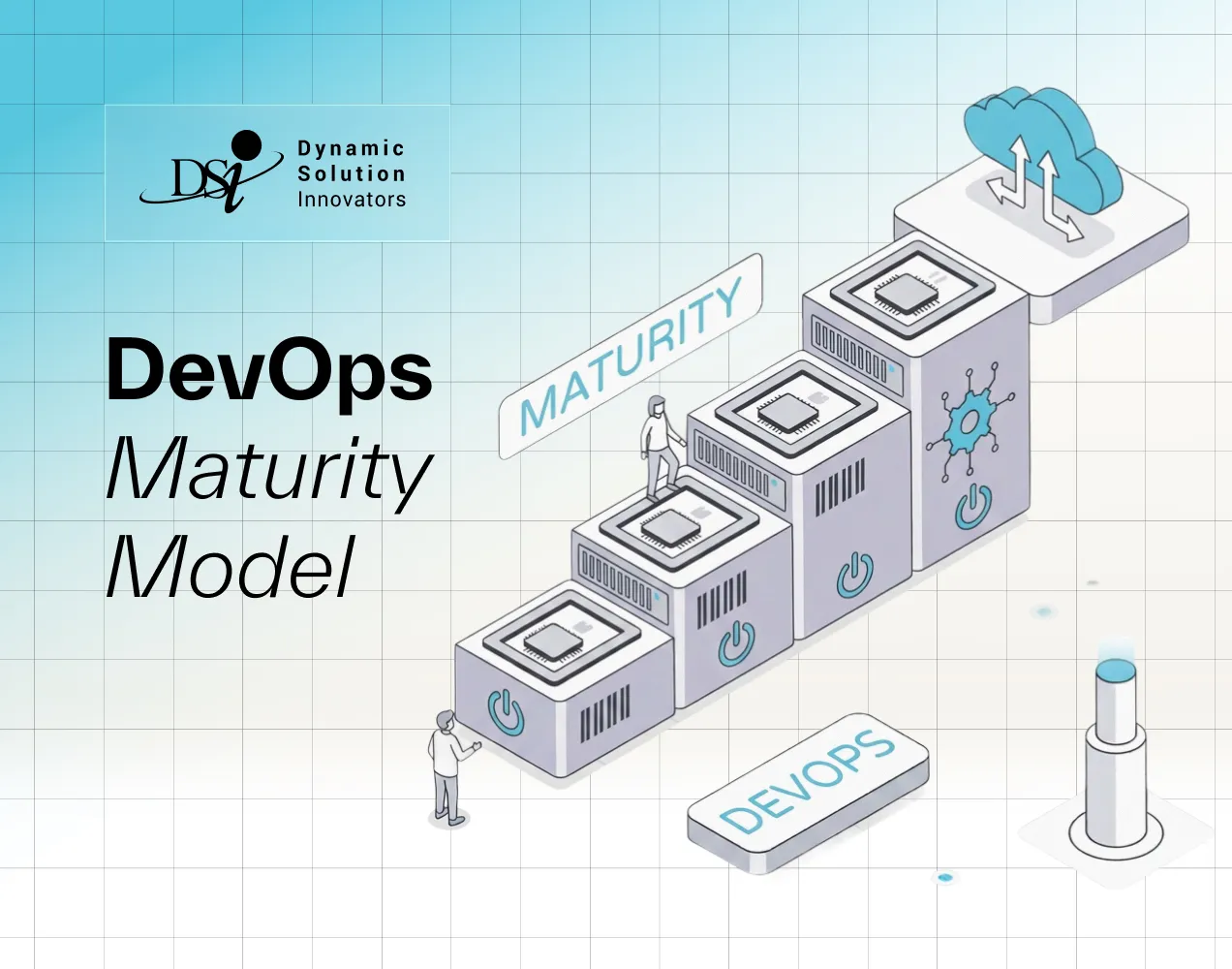
The 5 Levels of DevOps Maturity
DevOps maturity is not about how many tools you have installed. It is about how well your people, processes, and technology work together to deliver software reliably and quickly. Here are the five levels, with concrete indicators for each.
Level 1: Initial / Ad Hoc
At this level, there is no standardized process. Individual developers or teams handle deployments differently. Success depends on tribal knowledge — the one person who knows how to deploy to production.
- Deployments are manual, often involving SSH and running scripts by hand
- No consistent version control strategy — some code may not even be in a repository
- Testing is manual and inconsistent, often skipped under deadline pressure
- Environment setup requires following a wiki page that is probably outdated
- Monitoring is limited to "someone checks the server when a customer complains"
- Deployment frequency: monthly or less, often batched into large releases
Level 2: Managed
The team has recognized the need for structure and has started putting basic practices in place. Processes exist but are not consistent across teams or projects.
- All code is in version control with a defined branching strategy
- A CI server runs automated builds and some tests on each commit
- Deployments follow a documented process, though parts may still be manual
- Development environments are somewhat standardized (Docker Compose, Vagrant)
- Basic monitoring exists — uptime checks, application logs in a central location
- Deployment frequency: weekly to biweekly
Level 3: Defined
DevOps practices are standardized across the organization. There are clear, repeatable processes that every team follows. Automation covers the critical path from code commit to production.
- Infrastructure is defined as code (Terraform, Pulumi, CloudFormation)
- Full CI/CD pipelines automatically build, test, and deploy to staging and production
- Comprehensive monitoring and alerting with dashboards that the team actively watches
- Security scanning is integrated into the pipeline (SAST, dependency scanning)
- Incident response has a defined process with runbooks
- Deployment frequency: multiple times per week
Level 4: Measured
The organization not only follows best practices but measures their effectiveness. Decisions are driven by data, and the team continuously tracks key performance indicators.
- DORA metrics are tracked and reviewed regularly (deployment frequency, lead time, change failure rate, MTTR)
- SLOs and SLIs are defined for every service, with error budgets that inform release decisions
- Infrastructure costs are monitored and optimized through automated right-sizing
- Chaos engineering experiments run regularly to test system resilience
- Post-incident reviews produce actionable improvements, not blame
- Deployment frequency: daily or on-demand
Level 5: Optimized
The highest level of maturity. The organization has a culture of continuous improvement where systems are self-healing, developer experience is a first-class concern, and the platform enables autonomous teams.
- Self-healing infrastructure automatically recovers from common failure modes
- An internal developer platform abstracts away infrastructure complexity for product teams
- Developer experience metrics (onboarding time, build times, cognitive load) are tracked and improved
- GitOps workflows with tools like ArgoCD or Flux provide declarative, auditable deployments
- Feature flags and progressive delivery enable zero-downtime experimentation
- Deployment frequency: on-demand, multiple times per day, with full confidence
Self-Assessment: Where Does Your Team Stand?
Use this comparison table to honestly assess your current maturity level. Look at each capability area and identify the column that best describes your team's current state. Your overall maturity level is typically determined by your weakest area — a team with Level 4 CI/CD but Level 1 monitoring is effectively operating at Level 1 during incidents.
| Capability | Level 1-2 | Level 3 | Level 4-5 |
|---|---|---|---|
| Version Control | Some code in repos; no branching strategy | All code in repos with PR reviews; GitFlow or trunk-based | Everything as code (infra, config, policies); trunk-based with feature flags |
| CI/CD | Manual builds; basic CI with some tests | Automated build, test, deploy pipeline to all environments | Progressive delivery; canary deployments; automated rollback |
| Infrastructure | Manual server setup; some scripts | IaC for all environments; immutable infrastructure | Self-service platform; auto-scaling; self-healing |
| Testing | Manual testing; some unit tests | Automated unit, integration, and e2e tests in pipeline | Chaos engineering; contract testing; testing in production |
| Monitoring | Uptime checks; reactive log checking | Centralized logging; APM; alerts with runbooks | SLO-based alerting; distributed tracing; proactive anomaly detection |
| Security | Periodic manual audits | Automated scanning in pipeline; secrets management | Policy as code; zero-trust; automated compliance |
| Culture | Ops and dev are separate teams | Shared responsibility; blameless post-mortems | Platform team enables autonomous product teams; developer experience focus |
Be honest with your assessment. Overestimating your maturity level is one of the most common mistakes we see. It leads to skipping foundational work and investing in advanced tooling that your team is not ready to maintain.
The Four DORA Metrics That Matter
The DORA (DevOps Research and Assessment) metrics, developed through years of research and now part of Google Cloud, are the industry standard for measuring software delivery performance. The 2022 Accelerate State of DevOps Report reinforced what earlier reports found: these four metrics cut through vanity numbers and tell you how your team actually performs.
| Metric | Low Performer | Medium Performer | High Performer | Elite Performer |
|---|---|---|---|---|
| Deployment Frequency | Monthly or less | Weekly to monthly | Daily to weekly | On-demand (multiple per day) |
| Lead Time for Changes | More than 6 months | 1 to 6 months | 1 day to 1 week | Less than 1 hour |
| Change Failure Rate | 46-60% | 16-30% | 6-15% | 0-5% |
| Time to Restore Service | More than 1 week | 1 day to 1 week | Less than 1 day | Less than 1 hour |
The critical insight from DORA research is that speed and stability are not trade-offs. Elite teams deploy more frequently and have lower failure rates. They ship faster because their automation, testing, and monitoring give them confidence that each deployment is safe. Teams that deploy rarely tend to batch changes, which increases risk and makes failures harder to diagnose.
If you are not tracking these metrics today, that is your first action item. You cannot improve what you do not measure. Even rough estimates — "we deploy about twice a month and our last three outages took between four hours and two days to resolve" — give you a starting baseline.
Moving from Level 1 to Level 2: Building the Foundation
The jump from Level 1 to Level 2 is about establishing the non-negotiable basics. If your team is at Level 1, resist the temptation to jump ahead to Kubernetes or service meshes. Get these fundamentals right first.
Version control everything
Every line of code, every configuration file, every database migration, and every deployment script should be in version control. Establish a branching strategy — trunk-based development is ideal, but even GitFlow is better than no strategy. Require pull request reviews for all changes to the main branch.
Set up basic CI
Choose a CI platform — GitHub Actions and GitLab CI are the easiest to start with — and configure it to run on every push. At minimum, your CI pipeline should compile or build the project, run your existing unit tests (write some if you have none), and produce a deployable artifact. The goal is not perfection. The goal is that no code reaches production without being automatically built and tested at least once.
Automate your test suite
You do not need 100 percent test coverage. You need enough automated tests that your team trusts the CI pipeline to catch obvious regressions. Start with tests for your most critical business logic, integration tests for your most-used API endpoints, and smoke tests that verify the application starts correctly. A dedicated QA specialist can help you identify the highest-value tests to write first.
Standardize environments
Eliminate "works on my machine" by containerizing your application with Docker. Create a Docker Compose setup that lets any developer run the full application stack locally with a single command. This alone will save your team dozens of hours per month in environment debugging.
Moving from Level 2 to Level 3: Standardization
Level 3 is where DevOps starts paying serious dividends. The transition from Level 2 to Level 3 is about turning manual processes into automated, repeatable systems.
Infrastructure as Code
Stop creating infrastructure through cloud console UIs. Define every server, database, network configuration, and DNS record in Terraform, Pulumi, or CloudFormation. Store it in version control. Review infrastructure changes through the same pull request process as application code. This is not optional for Level 3 — it is the defining characteristic. A skilled cloud platform engineer can accelerate this transition significantly.
Full CD pipelines
Extend your CI pipeline into continuous delivery. Every commit that passes tests should be automatically deployed to a staging environment. Production deployments should be a single button click or an automatic promotion from staging after a defined soak period. No more SSH, no more manual file copying, no more "run these five commands in this order."
Monitoring and alerting
Implement comprehensive observability across three pillars: metrics (application and infrastructure performance data), logs (centralized, searchable, structured), and traces (request flows across services). Set up alerts for meaningful conditions — not "CPU above 80 percent" but "error rate exceeds 2 percent for the payments service over a 5-minute window." Write runbooks for every alert so that whoever is on call knows exactly what to check first.
Security scanning in the pipeline
Integrate static analysis (SAST), dependency vulnerability scanning, and container image scanning into your CI/CD pipeline. These should run on every pull request and block merges when critical vulnerabilities are detected. Pair this with a secrets management solution like HashiCorp Vault or AWS Secrets Manager — no more credentials in environment variables or config files.
Moving from Level 3 to Level 4: Measurement
Level 4 is where you shift from "we follow best practices" to "we measure and optimize." The tools and processes are in place. Now you need the data to drive continuous improvement.
DORA dashboards
Build dashboards that track all four DORA metrics in real time. Tools like Sleuth, LinearB, and Haystack can pull data from your CI/CD pipelines, incident management systems, and version control to calculate these automatically. Review these metrics weekly as a team. Set targets for each metric and track progress over quarters, not days.
SLOs, SLIs, and error budgets
Define Service Level Objectives for every user-facing service. "The checkout API will respond in under 500 milliseconds for 99.9 percent of requests." Back these SLOs with Service Level Indicators — the actual measurements. Calculate error budgets — the amount of unreliability you can tolerate before pausing new feature work to focus on stability. This framework transforms reliability from a subjective feeling into an objective, measurable standard.
Cost optimization
At Level 4, you should know exactly how much each service costs to run and have automated processes to optimize spending. Implement auto-scaling that responds to actual load, right-size instances based on utilization data, and use spot or preemptible instances for non-critical workloads. Tag all resources for cost attribution so every team knows their infrastructure spending.
Chaos engineering introduction
Start running controlled experiments to test your system's resilience. Begin with simple failure injection — kill a container, simulate network latency between services, fill a disk. The goal is to discover weaknesses in controlled conditions rather than during a 3 AM production outage. Tools like Gremlin and Litmus Chaos provide structured frameworks for running these experiments safely.
Moving from Level 4 to Level 5: Optimization
Level 5 is aspirational for most organizations. Very few teams operate at this level consistently. It requires not just technical excellence but organizational commitment to developer experience and continuous improvement.
Self-healing systems
Build infrastructure that detects and recovers from common failure modes without human intervention. Auto-restart crashed processes. Automatically scale up when traffic spikes are detected. Route traffic away from unhealthy instances. Automatically rollback deployments that breach error budgets. The goal is that your on-call engineer sleeps through incidents that the system handles on its own.
Platform engineering
Platform engineering is emerging as one of the most important trends in DevOps. The idea is to build an internal developer platform that abstracts away infrastructure complexity. Product engineers should be able to deploy a new service, set up a database, configure monitoring, and create a CI/CD pipeline without filing a ticket with the ops team. Backstage (open-sourced by Spotify) is gaining rapid adoption as the foundation for internal developer portals, and custom Kubernetes operators can extend the platform with self-service capabilities. This is how you scale an engineering team without linearly scaling your infrastructure team.
Developer experience metrics
Track and optimize the developer experience: time to first commit for new engineers, average build and test cycle time, time spent waiting for CI/CD pipelines, cognitive load required to make a production deployment. If your developers spend 30 percent of their time fighting tooling instead of building features, you have a DevOps problem regardless of how sophisticated your pipeline is.
GitOps and declarative operations
Adopt GitOps as the operational model for infrastructure and application delivery. Tools like ArgoCD and Flux watch Git repositories for changes and automatically reconcile cluster state to match the declared configuration. Every infrastructure change is a pull request — reviewed, approved, auditable, and reversible. This model eliminates configuration drift, provides a complete audit trail, and makes rollbacks as simple as reverting a commit. GitOps is quickly becoming the standard operating model for teams running Kubernetes at scale.
Common Pitfalls at Each Stage
After working with engineering teams across dozens of organizations — from startups to enterprises — we have seen the same mistakes repeat at each maturity level. Recognizing these patterns can save you months of wasted effort.
Level 1 to 2 pitfalls
- Tool-first thinking: Buying an expensive CI/CD platform before establishing basic version control discipline. The tool will not fix a broken process.
- Skipping tests: Setting up CI that only compiles code and does not run tests. A green build that has never been tested gives false confidence.
- One-person dependency: Having a single "DevOps person" who owns everything. If they leave, your entire pipeline becomes tribal knowledge again.
Level 2 to 3 pitfalls
- Partial IaC: Defining servers in Terraform but still manually configuring networking, DNS, or security groups through the console. IaC is all or nothing — partial adoption creates drift that is worse than no IaC at all.
- Alert fatigue: Setting up monitoring with hundreds of alerts that fire constantly. When everything is urgent, nothing is urgent. Start with fewer, more meaningful alerts.
- Security as afterthought: Building the full CD pipeline and then trying to bolt on security scanning later. Integrate security from the start.
Level 3 to 4 pitfalls
- Vanity metrics: Tracking metrics that look good in dashboards but do not drive action. "Number of deployments" is meaningless without change failure rate and recovery time.
- SLOs without consequences: Defining SLOs but never actually pausing feature work when error budgets are exhausted. SLOs only work if the organization respects them.
- Chaos without preparation: Running chaos experiments on systems that lack basic monitoring. You need to detect the impact before you can learn from it.
Level 4 to 5 pitfalls
- Over-engineering the platform: Building an internal developer platform that is more complex than the problems it solves. Start with the highest-pain developer workflows and automate those first.
- Automating bad processes: Self-healing systems that mask underlying architectural problems. If a service crashes every hour and auto-restarts, you still have a crashing service — you have just hidden the symptom.
- Ignoring the human side: Investing in tooling while neglecting team culture, documentation, and knowledge sharing. The most sophisticated platform is useless if engineers do not trust it or understand how to use it.
Building Your Maturity Roadmap
Improving DevOps maturity is not a weekend project. It is a sustained investment that compounds over time. Here is how to approach it practically.
- Assess honestly: Use the self-assessment table above to determine your current level. Get input from multiple people on the team — individual perspectives often differ, and the truth is usually the less optimistic assessment.
- Focus on one level at a time: Do not try to jump from Level 1 to Level 4. Each level builds on the foundations of the previous one. Skipping levels creates fragile systems that look advanced but break under pressure.
- Start with quick wins: At every level, there are changes that take days to implement and immediately improve developer productivity. Dockerizing the development environment, adding a basic CI pipeline, or setting up centralized logging. Ship these first to build momentum and demonstrate value.
- Measure before and after: Track your DORA metrics before starting any initiative so you can demonstrate concrete improvement. "We reduced deployment lead time from 3 days to 4 hours" is a compelling story for continued investment.
- Invest in people: Tools are the easy part. The harder work is building a culture where developers take ownership of operations, incidents are learning opportunities, and continuous improvement is a habit. This requires dedicated DevOps engineers who can both implement tooling and mentor the broader team.
Conclusion
DevOps maturity is not a destination — it is a direction. Even the most advanced engineering organizations are still improving their practices, adopting new tools like ArgoCD and Backstage, and refining their processes. The goal is not to reach Level 5 and declare victory. The goal is to be continuously moving up the maturity curve, delivering more value to users with less friction, less risk, and less manual effort.
The organizations that invest in DevOps maturity consistently outperform those that treat it as an afterthought. They ship faster, recover from failures quicker, spend less on infrastructure, and — critically — keep their best engineers. Nobody wants to work in an environment where deployments are stressful, incidents are chaotic, and every release is a gamble.
Start where you are. Pick the improvements that will have the highest impact at your current level. Measure the results. Then do it again. That rhythm of assess, improve, and measure is the real definition of DevOps maturity.
At DSi, our 300-engineer team includes experienced DevOps engineers and cloud platform engineers who have helped teams at every maturity level move to the next. Whether you need someone to set up your first CI/CD pipeline or architect a self-healing platform, let's talk about where you stand and what to improve next.