Your company needs more engineering capacity, and you need it fast. Maybe your product roadmap has outpaced your team's bandwidth. Maybe the Great Resignation has opened gaps you cannot fill through traditional hiring. Whatever the trigger, you are facing a decision that thousands of engineering leaders confront every year: should you augment your existing team with external engineers, or outsource the work entirely?
The answer is not one-size-fits-all. Staff augmentation and outsourcing solve fundamentally different problems, and choosing the wrong model can cost you months of lost productivity, budget overruns, and frustrated teams. In this guide, we break down both models in detail so you can make an informed decision based on your actual project needs, timeline, and budget.
Whether you are a startup CTO trying to ship faster or an enterprise VP of Engineering scaling a platform team, this comparison will give you a practical framework for choosing the right engagement model -- especially in a hiring environment where senior developers are harder to recruit and more expensive to retain than ever before.
What Is Staff Augmentation?
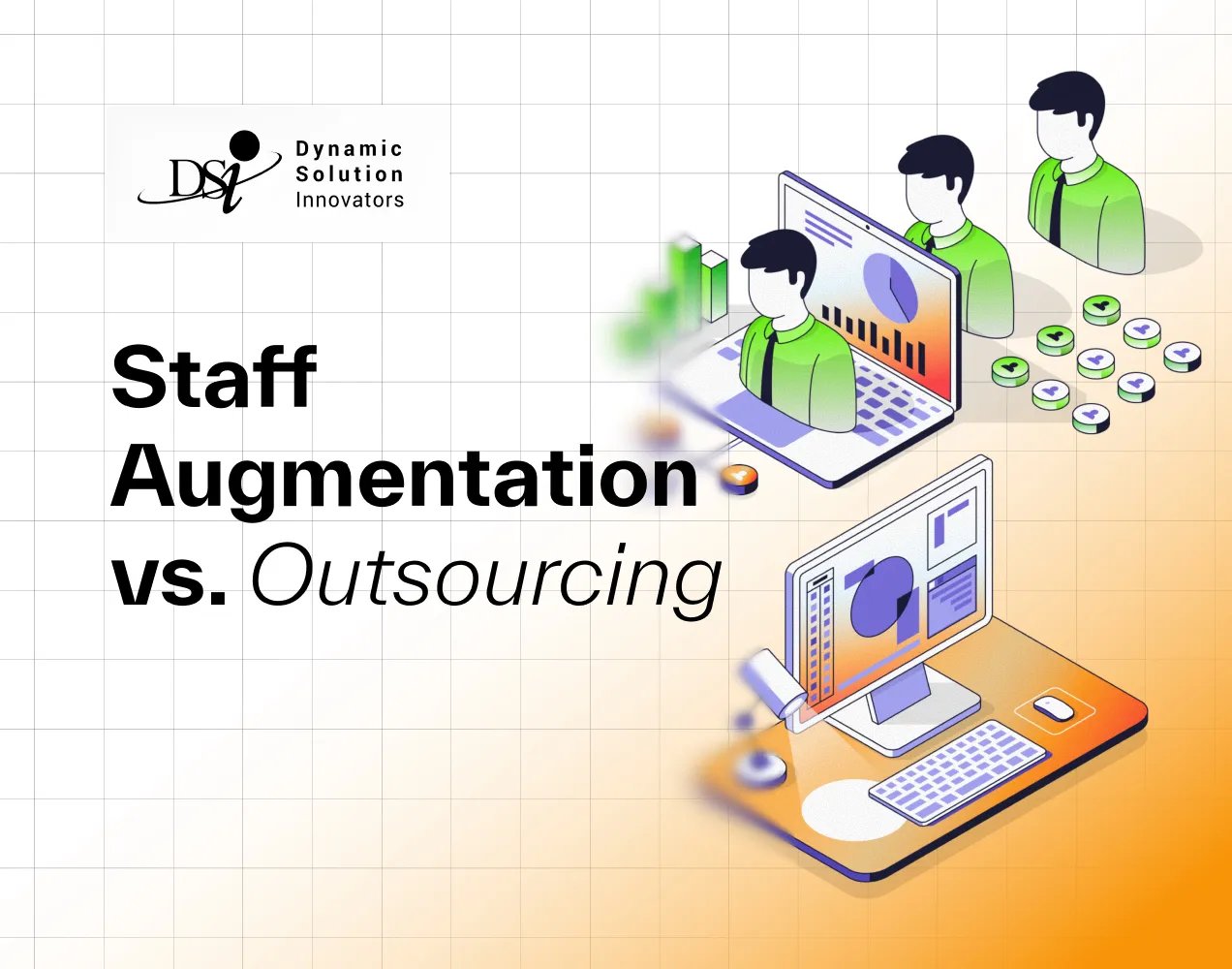
Staff augmentation is a hiring model where you bring external engineers into your existing team on a temporary or long-term basis. These engineers work under your direct management, follow your development processes, and integrate into your daily standups, sprint planning, and code review workflows.
Think of it as extending your in-house team without going through a full-time hiring cycle -- which, in the current market, can take three to four months for a senior engineer and often results in competing offers and lost candidates. The augmented engineers report to your technical leads, use your tools and repositories, and are accountable to the same standards as your internal developers.
How staff augmentation works in practice
A typical engagement starts with a partner like DSi identifying the skill gaps in your team. Need two senior React developers and a DevOps engineer? The provider sources, vets, and presents candidates who match your technical requirements and team culture. Once selected, the engineers onboard directly into your environment, often within one to two weeks.
You retain full control over what they work on, how they work, and what tools they use. The staffing partner handles payroll, benefits, and administrative overhead, while you manage the engineering output. With remote work now the norm across the industry, these engineers can integrate seamlessly regardless of geography.
Typical use cases for staff augmentation
- Scaling your team quickly for a product launch or major release cycle
- Filling specialized skill gaps (e.g., machine learning engineers, cloud architects, mobile specialists)
- Maintaining continuity on long-running projects when internal attrition creates gaps
- Supplementing your team during peak workload periods without committing to permanent headcount
- Building out a new engineering function where you want to retain architectural control
What Is Project Outsourcing?
Project outsourcing is a model where you hand off an entire project, module, or function to an external provider. The outsourcing company assembles their own team, manages the development process, and delivers the finished product according to agreed-upon specifications, timelines, and milestones.
Unlike staff augmentation, you are not managing the individual engineers. Instead, you are working with a project manager or delivery lead on the provider's side. You define the requirements and accept the deliverables, but the day-to-day execution is the provider's responsibility.
How outsourcing works in practice
The engagement begins with a detailed scoping phase where you define project requirements, acceptance criteria, and delivery milestones. The outsourcing provider then proposes a team composition, architecture approach, and timeline. Once the contract is signed, the provider's team works semi-independently, delivering progress updates at regular intervals and submitting work for review at predefined checkpoints.
Communication typically happens through a single point of contact on the provider's side, rather than direct interaction with every developer on the team.
Typical use cases for outsourcing
- Building a standalone application or module with well-defined requirements
- Developing a proof of concept or MVP where speed matters more than deep integration
- Offloading non-core work (e.g., internal tools, admin dashboards, legacy maintenance)
- Executing a project that requires a technology stack your team does not work with
- One-time development efforts where you do not need ongoing engineering capacity
Staff Augmentation vs. Outsourcing: Key Differences
The table below summarizes the core differences between staff augmentation and outsourcing across the dimensions that matter most to engineering leaders.
| Dimension | Staff Augmentation | Project Outsourcing |
|---|---|---|
| Management & Control | You manage the engineers directly; they follow your processes | The provider manages their team; you interface with a project lead |
| Team Integration | Engineers embed into your team, attend standups, and use your tools | External team works separately with periodic syncs and milestone reviews |
| Cost Structure | Hourly or monthly per-engineer rates; you control scope and hours | Fixed-price, milestone-based, or time-and-materials; scope changes incur change orders |
| IP Ownership | You retain full IP ownership by default (engineers work in your repos) | Must be explicitly defined in contract; code handoff happens at delivery |
| Scalability | Add or remove engineers flexibly as needs change | Team size is fixed per project scope; scaling requires contract renegotiation |
| Communication | Direct, real-time communication with each engineer | Filtered through project manager; less visibility into day-to-day decisions |
| Knowledge Transfer | Knowledge stays within your organization since engineers work in your codebase | Knowledge resides with the provider; transfer requires deliberate handoff |
| Onboarding Speed | 1-2 weeks to integrate into your workflow | 2-6 weeks for scoping, contracts, and project kickoff |
When to Choose Staff Augmentation
Staff augmentation is the stronger choice when you need to maintain control over your engineering output and want external talent to operate as a seamless extension of your in-house team. Here are the scenarios where it consistently delivers the best results.
1. You have an existing team that needs more bandwidth
If your internal team is experienced but understaffed -- a situation that has become increasingly common as the Great Resignation continues to move senior talent between companies -- augmentation lets you add capacity without disrupting your established workflows. The augmented engineers adopt your coding standards, participate in your sprint ceremonies, and contribute to your shared codebase from day one.
2. You need specialized skills on a flexible timeline
Building a machine learning capability or migrating to a new cloud platform? Augmentation lets you bring in specialists for exactly the duration you need them. With specialized developers commanding top dollar in today's market, the flexibility to engage them temporarily rather than committing to a full-time salary is a significant advantage.
3. You want to retain architectural control
For core products where technical decisions have long-term consequences, keeping the decision-making in-house is critical. Augmented engineers contribute code, but your architects and tech leads drive the direction. This matters enormously for enterprise-grade systems where architectural choices affect scalability, security, and maintainability for years.
4. Your project scope is evolving
In agile environments where requirements shift frequently, augmentation provides the flexibility to pivot without renegotiating contracts. Your augmented engineers simply move with the team to whatever the next priority is, just like your internal developers.
5. IP sensitivity is high
When you are building proprietary technology or working in regulated industries, having every engineer work within your controlled environment minimizes IP risk. All code is committed to your repositories, reviewed by your leads, and subject to your security policies.
When to Choose Outsourcing
Outsourcing is the better model when you have a clearly defined deliverable and want to hand off execution to a team that can operate independently. These are the scenarios where outsourcing shines.
1. The project has well-defined requirements and a fixed scope
If you can write a detailed specification and the requirements are unlikely to change significantly, outsourcing allows you to lock in a fixed price and timeline. This works well for standalone applications, data migrations, or compliance-related development where the end state is clearly understood.
2. You lack internal engineering leadership for the project
If you do not have a technical lead who can manage additional engineers, outsourcing provides built-in project management. The provider handles sprint planning, code reviews, and quality assurance internally, freeing you to focus on other priorities.
3. The work is non-core to your business
Internal tools, admin portals, marketing websites, and other non-core development tasks are strong candidates for outsourcing. Your internal team stays focused on the product that generates revenue while an external team handles supporting systems.
4. You need a one-time deliverable, not ongoing capacity
If the project has a clear end date and you will not need ongoing engineering support afterward, outsourcing avoids the overhead of integrating engineers into your team for a short engagement. Build it, hand it off, and move on.
5. You want budget predictability
Fixed-price outsourcing contracts provide certainty about total project cost, which can be easier to budget and justify internally, especially for non-technical stakeholders who want a clear number tied to a clear deliverable.
Cost Comparison: Staff Augmentation vs. Outsourcing
Cost is often the deciding factor, but the comparison is more nuanced than it appears. The cheapest option on paper can become the most expensive one in practice if you choose the wrong model -- and with developer compensation at all-time highs, the financial stakes are significant.
Staff augmentation cost structure
With staff augmentation, you pay a monthly rate per engineer, typically ranging from $4,000 to $12,000 depending on the role, seniority, and region. This rate covers the engineer's salary, benefits, equipment, and the staffing partner's margin. You have full control over how many hours and sprints each engineer works, and you can scale the team up or down with reasonable notice (usually two to four weeks). Compared to hiring a full-time senior developer domestically -- where total compensation packages now regularly exceed $150,000 to $200,000 -- augmentation from regions with strong engineering talent can offer substantial savings.
For a deeper breakdown of what dedicated engineering teams cost across different regions and seniority levels, see our comprehensive cost guide.
Outsourcing cost structure
Outsourcing projects are typically billed as fixed-price contracts (ranging from $25,000 to $500,000+ depending on complexity), time-and-materials agreements, or milestone-based payments. The total cost includes not just development but also project management, QA, and delivery overhead, which are baked into the price.
Hidden costs to watch for
- Staff augmentation: Onboarding time (the first two to four weeks are less productive as engineers ramp up), management overhead on your side, and potential turnover if augmented engineers leave and need replacement.
- Outsourcing: Change order fees when requirements shift, communication overhead from working across organizational boundaries, rework costs if the delivered product does not match expectations, and knowledge transfer costs at project completion.
ROI considerations
Staff augmentation tends to offer better long-term ROI when you need sustained engineering capacity because knowledge accumulates within your organization. Outsourcing can deliver better short-term ROI for well-defined projects because you pay for a deliverable rather than time, and the provider absorbs the risk of execution.
The cheapest engagement model is the one that matches your actual needs. A $50,000 outsourced project that delivers exactly what you specified is a better deal than six months of augmented engineers building something your requirements could not fully articulate.
How to Decide: A Practical Framework
Rather than defaulting to one model based on instinct or past experience, use these five questions to guide your decision.
Question 1: How well-defined are your requirements?
If you can write a complete specification with clear acceptance criteria, outsourcing is viable. If requirements will evolve through discovery and iteration, staff augmentation gives you the flexibility to adapt without change orders.
Question 2: Do you have engineering leadership to manage additional people?
Staff augmentation requires your team to manage, mentor, and review the work of augmented engineers. If your leads are already at capacity -- or if you have lost a key technical leader to the ongoing talent shuffle -- outsourcing offloads that management burden. If you have strong leads who want more builders, augmentation lets them scale their impact.
Question 3: Is this core or non-core work?
Core product work benefits from the tight integration and knowledge retention that staff augmentation provides. Non-core work can be outsourced without significant risk to your competitive advantage.
Question 4: What is your timeline?
If you need engineers producing code within two weeks, augmentation is faster to start. If you can invest four to six weeks in scoping and kickoff for a more hands-off execution, outsourcing may be a better fit.
Question 5: How long will you need this capacity?
For engagements longer than six months, staff augmentation almost always wins on cost and knowledge retention. For projects with a clear end date under three months, outsourcing can be more efficient.
The hybrid approach
Many companies find that the best answer is not either-or. A hybrid model lets you augment your core product team with dedicated engineers while outsourcing specific modules or functions. For example, you might embed two enterprise solution engineers into your platform team while outsourcing the development of an internal reporting dashboard. This gives you control where it matters most and efficiency where it does not.
Conclusion
Staff augmentation and outsourcing are not competing models; they are different tools for different problems. Staff augmentation gives you control, flexibility, and knowledge retention for ongoing engineering needs. Outsourcing gives you predictability, hands-off execution, and efficient delivery for well-scoped projects.
The right choice depends on your requirements clarity, management capacity, project criticality, timeline, and budget. In a market where hiring full-time engineers is slower and more expensive than ever, both models offer a way to keep shipping without compromising on quality. Use the five-question framework above to evaluate your specific situation rather than defaulting to one model.
At DSi, we help engineering teams scale through both staff augmentation and dedicated team models. Whether you need two senior developers embedded in your team next week or a full project delivery squad, we can help you find the right structure. Talk to our engineering leadership to figure out which model fits your needs.