Not every product idea needs a full engineering team and a 12-month roadmap. But not every idea can survive as a quick proof of concept either. The decision of where to start — POC, MVP, or full product build — is one of the most consequential choices a product leader makes, and getting it wrong costs real money and real time.
Start too small and you spend months validating what the market already knows. Start too big and you burn through six figures building features nobody wants. The gap between a two-week proof of concept and a year-long product build is not just scope — it is fundamentally different in purpose, audience, and what you learn from the process.
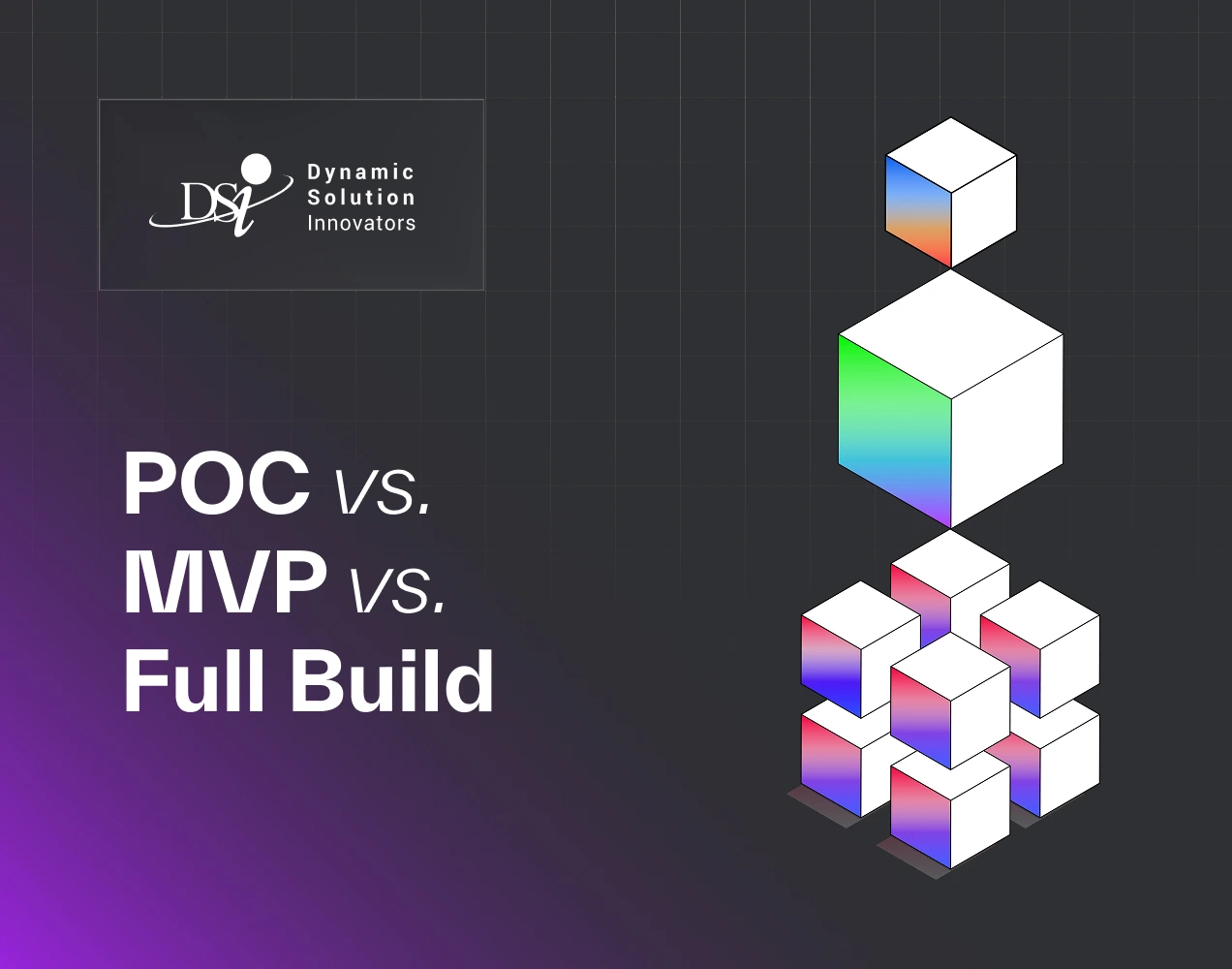
This guide breaks down the three approaches — proof of concept (POC), minimum viable product (MVP), and full product build — with practical frameworks for choosing your starting point. In 2025, the lines between these stages are shifting as AI-powered prototyping tools and no-code platforms make it faster than ever to validate ideas. But faster tools do not eliminate the need for strategic thinking about where to start. Whether you are a funded startup validating a new idea, an enterprise exploring a new technology, or an established business extending into adjacent markets, understanding these distinctions will save you from the two most expensive mistakes in product development: building too much too soon, and building too little too late.
What Is a Proof of Concept (POC)?
A proof of concept answers one question: can this actually work? It is a technical exercise designed to validate feasibility before you invest in building a real product. A POC does not need to look good, handle edge cases, or support real users. It needs to prove that the core technical approach is viable.
Purpose and scope
The purpose of a POC is to reduce technical risk. You build one when there is a genuine question about whether your idea is technically possible, whether a specific integration will work, or whether a particular technology can deliver the performance you need. The audience is internal — your engineering team, your stakeholders, your investors. Not end users.
A well-scoped POC is narrow by design. It targets the single riskiest assumption in your product idea and tests that assumption in isolation. If you are building a document processing platform, the POC might test whether your chosen OCR engine can accurately extract data from the specific document formats your customers use. Nothing more.
Timeline and investment
A POC should take 2 to 4 weeks. If it is taking longer, you are building too much. With AI-assisted coding tools now widely available, some focused POCs can be completed even faster — what used to take a week of integration work can sometimes be prototyped in days. The code quality in a POC is intentionally disposable — hardcoded configurations, minimal error handling, no tests, no deployment pipeline. You are optimizing for speed of learning, not code quality. The POC code gets thrown away. What you carry forward is the knowledge.
What a good POC delivers
- A definitive answer to a specific technical question
- Identified technical constraints or limitations that will shape the product architecture
- Performance benchmarks against your requirements (latency, accuracy, throughput)
- A rough estimate of the engineering effort needed for a production implementation
- Enough evidence to justify (or kill) the next phase of investment
What Is a Minimum Viable Product (MVP)?
An MVP answers a different question: do people actually want this? While a POC validates technology, an MVP validates the market. It is a working product — stripped to its core value proposition — that real users can interact with and provide feedback on.
Purpose and scope
The purpose of an MVP is to test product-market fit with the smallest possible investment. The audience is early adopters — real users who experience a real problem and are willing to try an imperfect solution. An MVP is not a demo. It is not a prototype. It is a functional product that delivers genuine value, even if that value is limited in scope.
The scope of an MVP is the core value proposition and nothing else. If your product helps teams manage projects, the MVP might include task creation, assignment, and status tracking. It does not include time tracking, resource planning, Gantt charts, or integrations with 15 other tools. Those come later, after you have validated that your core workflow is something users actually adopt.
Timeline and investment
A typical MVP takes 6 to 12 weeks to build with a focused team of 2 to 5 engineers. For some use cases, no-code and low-code platforms like Bubble, Retool, or Webflow can accelerate the MVP timeline to 3 to 6 weeks by eliminating boilerplate development — though they come with trade-offs in customization and scalability. Whether you build custom or use a platform, the code quality must be production-grade — not gold-plated, but solid enough to support real users without constant firefighting. You need authentication, basic error handling, a deployment pipeline, and enough monitoring to know when things break. The MVP is not disposable. It is the foundation you will build on.
What a good MVP delivers
- A working product that early adopters can use to solve a real problem
- Measurable user engagement data — sign-ups, activation rates, retention, feature usage
- Direct user feedback on what works, what is missing, and what does not matter
- Validated (or invalidated) assumptions about your target user and their willingness to pay
- A technical foundation that can evolve into the full product without a complete rewrite
What Is a Full Product Build?
A full product build is what happens when you have validated both the technology and the market, and you are ready to scale. The purpose shifts from learning to execution — building the complete feature set, hardening the infrastructure, and preparing the product for sustained growth and monetization.
Purpose and scope
The audience for a full product build is your target market — not just early adopters willing to tolerate rough edges, but mainstream users who expect the product to work reliably, handle their edge cases, and integrate with their existing workflows. The scope is the complete feature set defined by your product roadmap, built to production standards with scalability, security, and compliance requirements addressed from the start.
Timeline and investment
A full product build typically takes 3 to 12 months depending on complexity, with teams ranging from 5 to 20+ engineers. This is where you invest in architecture that scales, comprehensive testing, CI/CD pipelines, monitoring and alerting, documentation, and the operational capabilities needed to support a growing user base. The investment is significant — often $200,000 to $1,000,000+ for a serious software product — which is exactly why you validate with a POC and MVP first.
What a full product build delivers
- A complete product experience that addresses the full scope of your target users' needs
- Scalable architecture that handles growth without re-engineering
- Robust security, compliance, and data governance for enterprise and regulated markets
- Integrations with third-party tools and platforms that your users depend on
- The operational foundation for monetization — billing, analytics, customer support tooling
POC vs. MVP vs. Full Product: Side-by-Side Comparison
The differences between these three approaches are not just about scope and timeline. They differ in purpose, audience, code quality, and what success looks like.
| Dimension | POC | MVP | Full Product |
|---|---|---|---|
| Primary question | Can this work? | Do people want this? | Can this scale and sustain? |
| Purpose | Validate technical feasibility | Validate market demand | Scale and monetize |
| Target audience | Internal team, investors | Early adopters | Target market |
| Scope | Narrow (one hypothesis) | Core value prop only | Complete feature set |
| Timeline | 2-4 weeks | 6-12 weeks | 3-12 months |
| Team size | 1-2 engineers | 2-5 engineers | 5-20+ engineers |
| Code quality | Disposable | Production-grade foundation | Production-hardened |
| User-facing? | No (internal demo only) | Yes (limited audience) | Yes (general availability) |
| Investment | $5K-$25K | $30K-$150K | $200K-$1M+ |
| Success metric | Feasibility confirmed or denied | User engagement and retention | Revenue, growth, market share |
The most expensive mistake in product development is not choosing the wrong approach — it is skipping the validation steps. A $15,000 POC can save you from a $500,000 product nobody needs. A $60,000 MVP can prevent a $2,000,000 build based on untested assumptions.
When to Start with a POC
Not every product needs a POC. Start with one when there is genuine uncertainty about whether the technical approach will work. Here are the scenarios where a POC is the right first step.
Unproven technology
If your product depends on a technology your team has not used in production before — a new AI model integration, a novel data processing approach, a framework your team is unfamiliar with — a POC lets you validate that the technology actually delivers what you need before you commit to building on top of it. This is especially important for AI-powered products in 2025, where foundation model APIs like OpenAI and Claude make integration look deceptively easy, but model performance on your specific data and use case can be dramatically different from published benchmarks.
Complex integrations
When your product needs to integrate with legacy systems, third-party APIs with limited documentation, or proprietary data formats, a POC validates that the integration is technically possible and that the data quality meets your requirements. A two-week integration POC is far cheaper than discovering six months into a build that the data source cannot deliver what you need.
Stakeholder buy-in
In enterprise environments, technical leaders often need to demonstrate feasibility before securing budget for a full initiative. A POC provides tangible evidence — a working demo, performance benchmarks, technical architecture documentation — that stakeholders can evaluate when making funding decisions.
Regulatory feasibility
In regulated industries like healthcare, finance, and government, certain technical approaches may face compliance constraints that are not obvious until you attempt implementation. A POC can expose regulatory blockers early, before you invest in a full product design that turns out to be non-compliant.
When to Start with an MVP
Start with an MVP when the technology is proven (or straightforward) but the market is uncertain. The goal is to put a working product in front of real users as quickly as possible to validate demand.
Market validation is the primary risk
If your biggest question is not "can we build this?" but "will anyone use this?" — skip the POC and go straight to an MVP. The technology for most software products is well-understood. The risk is on the market side: is this a problem worth solving, are you solving it in the right way, and will users choose your solution over alternatives?
Competitive pressure
When competitors are moving fast or the market window is narrow, an MVP lets you establish a position and start learning from real users while competitors are still planning. Speed matters more than completeness. A functional product that exists today beats a perfect product that ships in eight months.
Funded startup with a thesis
If you have raised funding based on a clear product thesis and you need to demonstrate traction, an MVP is the fastest path to metrics that matter — user sign-ups, engagement, retention, and early revenue signals. In the product-led growth era, investors want to see real user data and self-serve activation metrics, not technical demos or slide decks. An MVP with built-in analytics gives you the data foundation for a PLG motion from day one.
User feedback is critical to the design
Some products can only be designed well through iteration with real users. If your product's success depends on understanding user workflows, preferences, and behaviors that you cannot fully predict, an MVP gives you the real-world data you need to make informed design decisions for the full product.
When to Go Straight to a Full Product Build
Sometimes you do not need to validate — you need to execute. Going straight to a full product build makes sense in specific situations where both the technology and the market are already well-understood.
Proven market with established demand
If you are entering a market with proven demand and clear customer expectations — building a CRM for a specific vertical, creating a compliance tool for a well-defined regulation, developing an ERP module for an underserved industry — you do not need to validate that the market exists. You need to build the product that serves it.
Established business extending into an adjacent product
When an existing company with an established customer base builds a new product that serves those same customers, the market validation is largely already done. You know your users, you understand their problems, and you have direct access to them for feedback throughout the build. The risk profile is fundamentally different from a startup launching into an unknown market.
Regulatory requirements demand completeness
In some regulated industries, you cannot launch a partial product. Healthcare platforms need HIPAA compliance from day one. Financial products need SOC 2 certification and regulatory approvals that require complete audit trails. Government contracts often specify minimum feature sets. In these cases, the MVP approach does not work because the minimum viable version must meet a regulatory floor that requires substantial engineering.
Replacing an existing system
When you are replacing a legacy system — migrating from a decades-old internal tool, rebuilding a product that already has users, or modernizing a platform that has accumulated technical debt — the requirements are already defined by what exists today. Users expect feature parity at minimum. A phased rollout still makes sense, but the overall scope is a full product build from the start.
The Progression Path: POC to MVP to Full Product
The most effective product development follows a progression where each phase builds on the learnings of the previous one. Understanding what to carry forward and what to leave behind is critical to moving efficiently through this pipeline.
From POC to MVP: what to carry forward
When a POC validates your technical approach, carry forward the learnings — not the code. The specific things that transfer are:
- Technical architecture decisions: Which technology stack works, which integrations are viable, what performance benchmarks are achievable
- Identified constraints: Rate limits, data format limitations, performance ceilings, and other technical boundaries that will shape the MVP design
- Estimated effort: The POC gives you a realistic sense of how long the production implementation will take, which directly informs MVP scoping and timeline
What you leave behind is the POC code itself. Resist the temptation to "clean up" POC code and use it as the MVP foundation. POC code was optimized for learning speed, not maintainability. Starting the MVP with a clean codebase and proper architecture saves time in the long run.
From MVP to full product: what to carry forward
The transition from MVP to full product is different — you are building on the MVP, not replacing it. What transfers:
- The codebase: Unlike POC code, MVP code is built to production standards and forms the foundation for the full product. Plan for refactoring and scaling, not rewriting.
- User data and feedback: Everything you learned from MVP users — feature usage patterns, support requests, churn reasons, feature requests — becomes the roadmap for the full product.
- Product-market fit signals: The retention metrics, conversion rates, and engagement data that tell you which parts of the product resonate and which need rethinking.
- The user base: Your MVP users are your first customers. Transitioning them smoothly to the full product — and rewarding their early adoption — builds the loyalty that drives growth.
What to throw away between phases
Every phase produces assumptions that do not survive contact with reality. Between each phase, actively identify and discard:
- Feature assumptions: Features you planned for the MVP that the POC proved unnecessary. Features you built into the MVP that users never touched.
- Market assumptions: User personas that turned out to be wrong. Pricing models that did not resonate. Go-to-market channels that did not convert.
- Technical assumptions: Performance estimates that were too optimistic. Integrations that looked simple but were not. Scaling approaches that work in theory but fail under real load.
The discipline to throw away what does not work is what separates efficient product development from expensive product development.
Common Mistakes at Each Stage
After building products across industries — from early-stage startups to enterprise platforms — these are the patterns that consistently derail product development at each stage.
Overbuilding the POC
The most common POC mistake is scope creep. What starts as a two-week feasibility test expands into a six-week mini-product because someone says "while we are at it, let's also test..." Every additional feature added to a POC dilutes its purpose and delays the answer you need. A POC should test one hypothesis. If you have five hypotheses, build five small POCs — do not build one large one.
The second POC mistake is treating disposable code as a foundation. Teams that spend four weeks "cleaning up" POC code to use in the MVP always end up with a fragile foundation that creates more problems than it solves. POC code was never meant to be production code. Let it go.
Underbuilding the MVP
The "minimum" in minimum viable product does not mean "barely functional." An MVP that crashes, loses data, or provides a confusing user experience does not validate market demand — it validates that broken software does not attract users. Your MVP needs to be good enough that a negative result means users do not want the product, not that your implementation was too poor to evaluate.
Specifically, MVPs fail when they cut corners on:
- Reliability: An MVP that crashes daily tells you nothing about market demand
- Core workflow: If the primary user journey is incomplete or confusing, you are testing your UX, not your product hypothesis
- Data integrity: Users who lose their data will never come back, regardless of how compelling your value proposition is
Skipping validation entirely
The most expensive mistake is going straight to a full product build without validating either the technology or the market. This happens most often when a founder is deeply convinced of their vision, when an executive makes a top-down decision based on intuition, or when competitive pressure creates artificial urgency. The result is almost always the same: six to twelve months and hundreds of thousands of dollars spent building a product that misses the mark.
Even when you have strong conviction, a two-week POC or a six-week MVP is cheap insurance against building the wrong thing.
Treating all three as the same process
A POC run like an MVP wastes time on production quality that will be thrown away. An MVP run like a full product build takes too long and costs too much to serve as a validation tool. A full product build run like an MVP results in technical debt that cripples the product as it scales. Each phase has its own pace, quality bar, and success criteria. Applying the wrong standards to the wrong phase is a reliable way to waste time and money.
Making the Decision: A Practical Framework
If you are staring at a product idea and trying to decide where to start, work through these questions in order:
- Is the technology unproven? If you are unsure whether the core technical approach will work — a new AI model, a complex integration, a performance requirement you have never hit before — start with a POC. Two to four weeks of focused technical validation will save you from building on a foundation that does not hold.
- Is the market unvalidated? If the technology is straightforward but you are not sure people will pay for the product — start with an MVP. Six to twelve weeks of focused building gets a working product in front of real users who will tell you, through their behavior, whether you are solving a real problem.
- Are both technology and market proven? If you know the technology works and you know the market exists — go straight to a full product build. Spending time on a POC or MVP when both are already validated is wasted motion.
- Are both technology and market uncertain? Start with a POC to validate the technology, then move to an MVP to validate the market. Do not try to validate both at the same time in one build — the feedback loops are different and you will end up with muddy answers to both questions.
How DSi Supports Each Phase
At DSi, we have built products across all three phases for US and European companies — from rapid POC validation to full-scale product launches with 300+ engineers. Our approach adapts to where you are in the product lifecycle:
- POC development: Small, focused teams (1 to 2 senior engineers) that validate your riskiest assumption in 2 to 4 weeks. We deliver a clear verdict on feasibility plus a technical roadmap for the next phase.
- MVP development: Cross-functional teams (3 to 5 engineers) that build a production-quality product focused on your core value proposition in 6 to 12 weeks. You get a working product, real user data, and a codebase that scales.
- Product scale-up: Full engineering teams that take your validated product to market with the complete feature set, infrastructure, and operational maturity needed for sustained growth.
- Product enhancement: Ongoing engineering support that extends your product's capabilities — new features, performance optimization, platform expansion — as your market evolves.
The right starting point depends on what you already know and what you still need to learn. If you are unsure, start a conversation with our product engineering team. We will help you figure out whether your next step is a two-week POC, an eight-week MVP, or a full product build — and then we will help you build it.