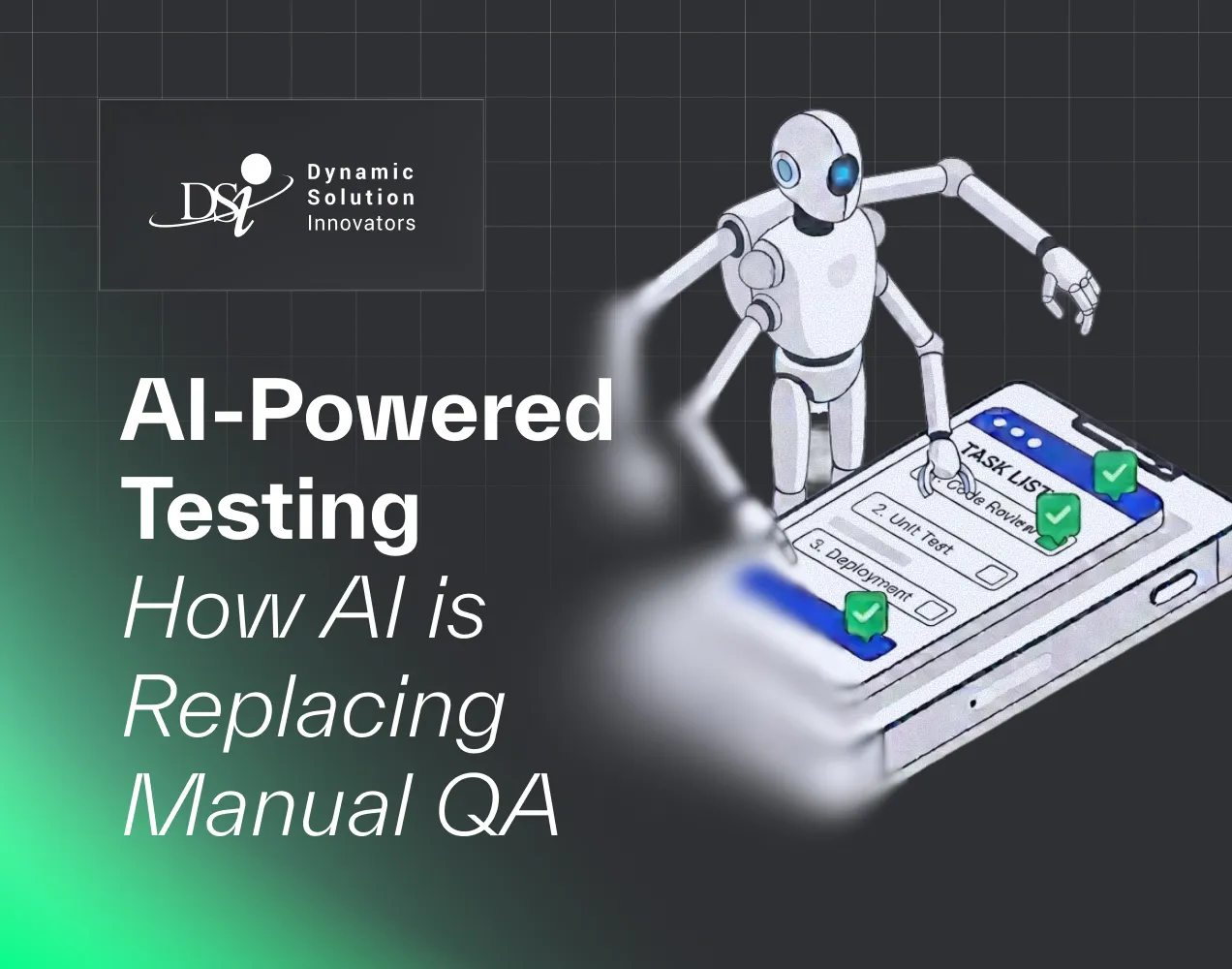
Manual QA has been the backbone of software quality for decades. Human testers click through interfaces, verify business logic, and find the edge cases that automated scripts miss. But today, artificial intelligence is fundamentally changing what that work looks like — and which parts of it still require a human being sitting at a screen.
The shift is not hypothetical. AI-powered test generation tools now write regression suites from application code. Visual regression engines compare screenshots pixel by pixel using neural networks instead of brittle DOM assertions. Self-healing locators fix their own selectors when developers change a button class or rearrange a layout. And AI exploratory testing tools crawl applications autonomously, finding bugs that no one wrote a test case for.
But here is what the vendor marketing will not tell you: AI is not replacing your QA team. It is replacing the repetitive, low-judgment parts of their work — the parts that burn out good testers and slow down release cycles. The high-judgment work, the kind that requires understanding user intent, business context, and real-world edge cases, still belongs to humans. The question is not "AI or manual QA." The question is how to combine them so your QA team catches more bugs, ships faster, and focuses on work that actually requires their expertise.
The State of AI in Software Testing
To understand where AI testing is headed, you need to understand where it actually is today — not where conference talks and LinkedIn posts suggest it is. The gap between AI testing hype and AI testing reality is wide, but the reality is still impressive enough to matter.
What AI testing can do well right now
AI has reached production-grade maturity in four specific areas of software testing:
- Test generation from code and requirements: Tools like CodiumAI and Diffblue analyze your source code, identify logical branches, and generate unit and integration tests that cover paths a human tester might miss. These tools do not just template tests — they reason about input boundaries, null cases, and exception paths.
- Visual regression testing: AI-powered tools like Applitools use trained neural networks to compare screenshots across builds. Unlike pixel-diff tools, they understand visual hierarchy and can distinguish between a meaningful UI change (a button moved from the header to the sidebar) and an irrelevant rendering difference (a one-pixel font rendering shift between browsers).
- Self-healing test locators: Platforms like Testim and Mabl use ML models trained on DOM structures to identify UI elements through multiple attributes. When a developer renames a CSS class or restructures a component, the AI recognizes the element by its text, position, visual context, and surrounding DOM, then automatically updates the selector.
- Intelligent test prioritization: AI analyzes code changes, historical failure data, and test execution patterns to determine which tests are most likely to catch bugs in a given build. Instead of running your entire regression suite on every commit, you run the 20 percent of tests that cover 80 percent of the risk.
What AI testing is getting better at
These capabilities are emerging but not yet reliable enough for most production environments:
- AI exploratory testing: Tools that autonomously crawl applications, interact with UI elements, and report anomalies. Think of it as a tireless junior tester who clicks every button and fills every form, 24 hours a day. The results still require human review, but the coverage is impressive.
- Natural language test authoring: Describing test scenarios in plain English and having AI convert them to executable test scripts. The accuracy has improved dramatically today, but complex multi-step flows with conditional logic still need manual refinement.
- AI-powered API testing: Generating API test suites from OpenAPI specifications, automatically testing edge cases like malformed payloads, missing headers, and rate limit boundaries.
AI Test Generation: Writing Tests That Humans Would Not
The most immediately impactful AI testing capability is automated test generation. Not because it writes perfect tests — it does not — but because it writes the tests that humans skip.
Every engineering team has the same problem: test coverage is concentrated on the happy path. The main user flows are well-tested. The edge cases, error paths, boundary conditions, and integration points are undertested because writing those tests is tedious and time-consuming. AI test generation tools attack exactly this gap.
How AI test generation works
Modern AI test generation tools operate at multiple levels:
- Static analysis: The AI reads your source code and identifies every logical branch — every if/else, every switch case, every try/catch. It then generates tests that exercise each branch, including the ones your team never wrote tests for because they seemed unlikely to fail.
- Behavioral analysis: For UI testing, the AI observes how the application behaves at runtime — which components render, which API calls fire, which state changes occur — and generates tests that verify these behaviors.
- Mutation testing integration: The AI intentionally introduces bugs into your code (changing a "greater than" to "less than," removing a null check) and verifies that existing tests catch the mutation. When they do not, it generates new tests that would.
The practical result: teams that adopt AI test generation typically see their code coverage increase by 20 to 40 percent within the first month, with most of the new coverage targeting edge cases and error paths that manual test writing neglected.
Visual Regression Testing with AI
Traditional visual regression testing compares screenshots pixel by pixel. If a single pixel changes, the test fails. This approach generates so many false positives that most teams either abandon visual testing entirely or spend more time reviewing false failures than finding real bugs.
AI-powered visual regression solves this by understanding what it sees. Instead of comparing pixels, neural networks trained on millions of UI screenshots evaluate whether a visual change is meaningful. A one-pixel shift in a border? Ignored. A button that changed from blue to red? Flagged. A modal that is now rendering behind the overlay instead of in front? Caught immediately.
Where AI visual regression excels
- Cross-browser consistency: Different browsers render fonts, shadows, and borders slightly differently. AI visual testing ignores these rendering variations while still catching genuine layout breaks across Chrome, Firefox, Safari, and Edge.
- Responsive layout verification: AI can evaluate whether a responsive layout is "correct" across breakpoints, understanding that elements should reflow and resize — not just checking if they match a static reference screenshot.
- Design system compliance: AI models can be trained on your design system's rules (spacing, color palette, typography scale) and flag violations automatically, even in components that do not have explicit visual tests.
- Accessibility regression: Some AI visual tools now detect contrast ratio violations, missing focus indicators, and text that falls below minimum size thresholds.
Self-Healing Test Locators: Ending the Maintenance Nightmare
Ask any test automation engineer what they spend most of their time on, and the answer is almost always the same: fixing broken locators. A developer renames a CSS class, restructures a component, or updates a third-party library, and suddenly 30 percent of the test suite fails — not because the application is broken, but because the selectors that identify UI elements are now stale.
Self-healing locators are the single highest-ROI AI testing capability for most teams. They eliminate the biggest maintenance cost in test automation.
How self-healing works
Instead of relying on a single locator strategy (CSS selector, XPath, or test ID), self-healing tools build a multi-attribute fingerprint for each element:
- The element's text content
- Its position relative to other elements
- Its visual appearance (size, color, shape)
- Its role in the accessibility tree
- Its surrounding DOM context (parent, siblings, children)
- Its historical locator patterns across previous test runs
When the primary locator fails, the AI evaluates the remaining attributes to identify the element with high confidence. If the match confidence exceeds a threshold — typically 85 to 95 percent — the test continues with the healed locator and logs the change for human review. If confidence is below the threshold, the test fails and flags the locator for manual investigation.
Teams that implement self-healing locators report a 60 to 80 percent reduction in test maintenance effort. That is not a small optimization — it is the difference between a test suite that your team actively maintains and one that slowly rots until no one trusts it.
AI-Powered Exploratory Testing
Exploratory testing has always been considered impossible to automate. By definition, it relies on human curiosity, intuition, and the ability to think "what happens if I do something unexpected?" Today, AI is not replacing exploratory testing, but it is augmenting it in a way that dramatically expands coverage.
How AI exploratory testing works
AI exploratory testing tools use a combination of reinforcement learning and LLM reasoning to interact with your application autonomously:
- Crawl and map: The AI navigates every reachable screen, building a model of the application's structure, available actions, and state transitions.
- Generate hypotheses: Based on the application model, the AI generates test hypotheses — "what happens if I submit this form with empty required fields?" or "what happens if I navigate back after a payment submission?"
- Execute and observe: The AI performs the actions and observes the results — console errors, HTTP error codes, unexpected UI states, performance degradation, and accessibility violations.
- Report anomalies: Instead of pass/fail assertions, AI exploratory testing reports anomalies ranked by severity and confidence. A human tester then reviews the findings to separate real bugs from false positives.
The value is not that AI exploratory testing finds bugs humans cannot — it is that it finds bugs humans would not have time to look for. A human tester might explore 50 to 100 scenarios in a session. An AI tool can explore thousands overnight, covering interaction patterns that no manual tester would prioritize.
Where AI Cannot Replace Human QA
This is the section that matters most. Understanding where AI testing falls short is more important than understanding where it excels, because over-relying on AI in the wrong areas creates a false sense of quality that leads to production incidents.
Usability and user experience testing
AI can verify that a button is visible and clickable. It cannot tell you that the button is in a confusing location, that the label is misleading, or that the workflow requires three unnecessary steps. Usability testing requires understanding human psychology, user expectations, and the mental models people bring to your application. No AI model can reliably evaluate whether an interface "feels right."
Business logic validation
AI test generation can cover code branches, but it cannot validate whether the business logic is correct in the first place. If your pricing calculation is wrong, AI will dutifully write tests that verify the wrong behavior. A human tester who understands the business domain will catch that the discount calculation should be 15 percent, not 1.5 percent — something an AI tool treats as equally valid outputs.
Edge cases that require domain knowledge
AI excels at finding technical edge cases — null inputs, boundary values, concurrent requests. It struggles with domain-specific edge cases that require understanding the real world: "What happens when a user is in a timezone where daylight saving time is observed? What about a user whose legal name contains special characters? What if a financial transaction spans a fiscal year boundary?" These scenarios come from experience with the domain, not from analyzing code.
Accessibility beyond automated checks
Automated tools (AI or otherwise) can check color contrast ratios, verify ARIA labels exist, and confirm keyboard navigation paths. They cannot evaluate whether a screen reader user can actually understand and use the application. True accessibility testing requires navigating the application with assistive technology and evaluating the experience holistically — something that requires human testers, ideally including testers with disabilities.
Security testing and threat modeling
AI can run automated security scans and identify known vulnerability patterns. It cannot think like an attacker. Threat modeling — understanding how your specific application, with its specific data and users, could be exploited — requires creative reasoning about adversarial scenarios. AI is a useful tool in a security tester's arsenal, but it is not a replacement for the human expertise that finds the vulnerabilities no scanner would think to look for.
AI Testing vs. Manual QA: Where Each Wins
| Testing Area | AI Testing | Manual QA | Best Approach |
|---|---|---|---|
| Regression testing | Excellent | Slow, error-prone | AI-driven with human review |
| Visual regression | Excellent | Tedious, inconsistent | AI-driven |
| Test maintenance | Self-healing locators | Major time sink | AI-driven |
| Edge case discovery | Good (technical) | Good (domain) | Both — AI for technical, human for domain |
| Usability testing | Poor | Excellent | Human-driven |
| Exploratory testing | Good (breadth) | Excellent (depth) | AI for breadth, human for depth |
| Business logic validation | Poor | Excellent | Human-driven |
| Performance testing | Good | Limited | AI-assisted with human analysis |
| Accessibility testing | Good (automated checks) | Excellent (holistic) | AI for scanning, human for evaluation |
| Security testing | Good (known patterns) | Excellent (creative) | AI for scanning, human for threat modeling |
Implementation Roadmap: Adding AI to Your QA Process
Adopting AI testing is not a one-weekend migration. It is a phased process that takes three to six months to produce meaningful results. Here is the practical roadmap based on what works for teams that integrate AI into their development lifecycle successfully.
Phase 1: Foundation (Weeks 1-4)
Start with the highest-ROI, lowest-risk AI testing capabilities:
- Deploy self-healing locators on your existing test suite. This immediately reduces maintenance burden and gives your team confidence that AI testing tools deliver real value.
- Set up AI visual regression for your critical user flows. Start with 10 to 15 key screens, not your entire application. Tune the sensitivity thresholds to minimize false positives.
- Integrate AI test prioritization into your CI pipeline. Start running the highest-risk tests first on every commit, with the full suite running on a scheduled basis.
Phase 2: Expansion (Months 2-3)
Build on the foundation with more advanced capabilities:
- Introduce AI test generation for new features. When developers merge code, AI generates suggested tests that reviewers can accept, modify, or reject. This builds the habit of AI-augmented testing without disrupting existing workflows.
- Expand visual regression coverage to all user-facing screens and add cross-browser and responsive testing.
- Begin AI exploratory testing in staging environments. Run autonomous crawls overnight and have human testers review the anomaly reports each morning.
Phase 3: Optimization (Months 4-6)
Refine and optimize the AI testing pipeline:
- Build feedback loops: Track which AI-generated tests catch real bugs, which produce false positives, and which areas of the application consistently need human testing. Use this data to tune the AI tools and allocate human testing effort more effectively.
- Integrate AI testing into developer workflows: Shift AI test generation left so developers get test suggestions in their IDE, not just in CI. This makes testing a development activity, not a post-development gate.
- Measure and report: Track metrics that matter — defect escape rate, time to detect regressions, test maintenance cost, and the ratio of AI-found bugs to human-found bugs. Use these metrics to justify continued investment and identify areas for improvement.
Realistic expectations by phase
| Metric | Phase 1 (Month 1) | Phase 2 (Month 3) | Phase 3 (Month 6) |
|---|---|---|---|
| Test maintenance reduction | 30-40% | 50-60% | 60-80% |
| Regression cycle time | 20% faster | 40% faster | 50-60% faster |
| Code coverage increase | 5-10% | 15-25% | 25-40% |
| False positive rate | High (tuning needed) | Moderate | Low (well-tuned) |
| Human tester focus shift | Mostly maintenance | Mixed | Mostly high-value testing |
Building Your AI-Augmented QA Team
The team structure for AI-augmented QA looks different from a traditional QA team. You still need testers who understand your product and domain. But you also need engineers who can configure, tune, and maintain the AI testing infrastructure.
The roles that matter
- QA automation engineer with AI tooling experience: This person owns the AI testing pipeline — configuring self-healing locators, tuning visual regression thresholds, managing AI test generation output, and maintaining the feedback loops that improve AI accuracy over time.
- Manual QA specialist (reframed): The "manual tester" role evolves into a high-judgment testing role. These testers focus exclusively on usability testing, exploratory testing of novel features, business logic validation, and accessibility evaluation. They review AI-generated anomaly reports and make the judgment calls that AI cannot.
- QA lead who understands AI capabilities and limitations: Someone who can look at your testing strategy and decide which tests should be AI-driven, which need human execution, and where the two should overlap. This role requires both traditional QA expertise and an honest understanding of where AI helps and where it creates a false sense of security.
If your team lacks AI testing experience, the fastest path is to bring in QA specialists who have already implemented these tools. Learning AI testing tooling through trial and error takes six to twelve months. Working alongside someone who has done it before compresses that to weeks.
Common Mistakes When Adopting AI Testing
Trusting AI test generation output without review
AI-generated tests can have the same problem as AI-generated code: they look correct but test the wrong thing. A test that asserts "the response status is 200" passes, but it does not verify that the response body contains the right data. Always have human testers review AI-generated tests before they become part of your permanent test suite.
Replacing human testers entirely
Some organizations see AI testing tools and immediately cut QA headcount. This is a mistake. The bugs that reach production after cutting human testers are the expensive ones — usability issues that drive users away, business logic errors that cause financial losses, and accessibility failures that create legal liability. AI catches the easy bugs cheaply. Humans catch the expensive bugs that AI misses.
Ignoring the false positive problem
Every AI testing tool generates false positives, especially in the first few weeks. If your team does not have a process for reviewing and tuning these alerts, they will quickly learn to ignore all AI-generated reports — including the ones that flag real bugs. Budget time for tuning during the first two months.
Adopting tools without changing process
Dropping AI tools into an unchanged QA process is like buying a dishwasher and continuing to wash dishes by hand. The value of AI testing comes from restructuring your QA process around it — shifting human effort from regression testing to exploratory testing, from maintaining locators to evaluating AI anomaly reports, from writing basic test cases to validating business logic. If the process does not change, the tools deliver marginal value.
Where AI Testing Is Headed Next
Based on the current trajectory, here is where AI testing is headed in the next two to three years:
- Autonomous test suite management: AI will not just generate and heal tests — it will manage the entire test suite, adding tests for new features, removing obsolete tests, and rebalancing coverage based on risk analysis. Human testers will review and approve changes rather than making them.
- Context-aware testing: AI testing tools will understand your application's business context — not just its code. They will know that a 0.1 percent pricing error on a high-volume ecommerce site is more critical than a misaligned icon on a settings page, and prioritize accordingly.
- Unified AI testing platforms: Today's fragmented tooling (one tool for visual regression, another for self-healing, another for test generation) will consolidate into platforms that handle the full AI testing lifecycle. This will reduce integration overhead and improve the feedback loops between different testing capabilities.
- AI-human collaborative testing sessions: Instead of AI and humans testing separately, future tools will support real-time collaboration where AI suggests areas to explore, humans investigate, and AI learns from human decisions to improve future suggestions.
Conclusion
AI is not replacing QA. It is replacing the parts of QA that should have been automated years ago — the repetitive regression runs, the brittle locator maintenance, the tedious pixel-by-pixel screenshot comparisons. These tasks burned out talented testers and slowed down release cycles without requiring the human judgment that makes great QA professionals valuable.
The teams that will have the best software quality are not the ones that adopt the most AI testing tools or the ones that cling to purely manual processes. They are the teams that draw a clear line between what AI should own and what humans should own, and then staff and tool both sides appropriately.
Start with self-healing locators and visual regression — the highest-ROI, lowest-risk capabilities. Expand to AI test generation and exploratory testing as your team builds confidence. Reallocate the time your testers save from maintenance to the high-judgment work that actually prevents production incidents. And measure everything, because the only way to know if AI testing is working is to track the metrics that matter: bugs escaped, time to detect, and the cost of quality.
At DSi, our QA specialists and AI engineers help engineering teams implement AI-powered testing strategies that actually work — from tool selection and pipeline setup to team restructuring and process redesign. Whether you are starting from manual testing and want to modernize, or you have existing automation that needs AI augmentation, talk to our engineering team about building a QA process that scales.